
(all prices in this piece are split adjusted for the 4-1 stock split in December 2025; we don’t go back beyond 2019. Masa loves stock splits since 100 shares at the 1994 IPO are now 35,784 shares)
Softbank Group Corporation (9984 - not be confused with Softbank Corp 9434 which supplies communication services and is 40% owned) is the top listed company in the Masayoshi Son empire. It continues to be the most fascinating case study. I’ll refer to it as “9984”. Having ridden through (at least) two complete cycles since public listing in 1994, encompassing massive gains from the dot.com boom (mainly via shareholding in Yahoo! and the spin of Yahoo Japan) and then the near 900x return from a small investment in Alibaba, Masa is onto exploitation of his third mega cycle - AI. I’ve followed the company for around seven years, with the spreadsheets to prove it.
This isn’t a detailed piece on Softbank and its history. If you want that, read two books (I have). The historical record: “Gambling Man: The Secret Story of the World's Greatest Disruptor, Masayoshi Son" by Lionel Barber (2025). The insider view: “The Money Trap” by Alok Sama (2024) the company’s ex-CFO.
This piece is just a mild, limited detail observation on how we’ve seen this pattern in the company’s securities on previous occasions, and what it may tell us about the cycle we are in. 9984 has historically been a poster-child for enthusiastic excess in the technology sector; it will exhibit some of these traits again, but with less financial gearing than last time around, and in any down cycle, may not give quite as much of a fright.
What is 9984 and how is it structured?
9984 has just under 5.7billion issued shares at ¥6540 for a market capitalisation of ¥37.3trillion or US$243billion. Masa has a direct ownership of 32.7% and an indirect interest of a further 4%.
9984 has two major listed subsidiaries:
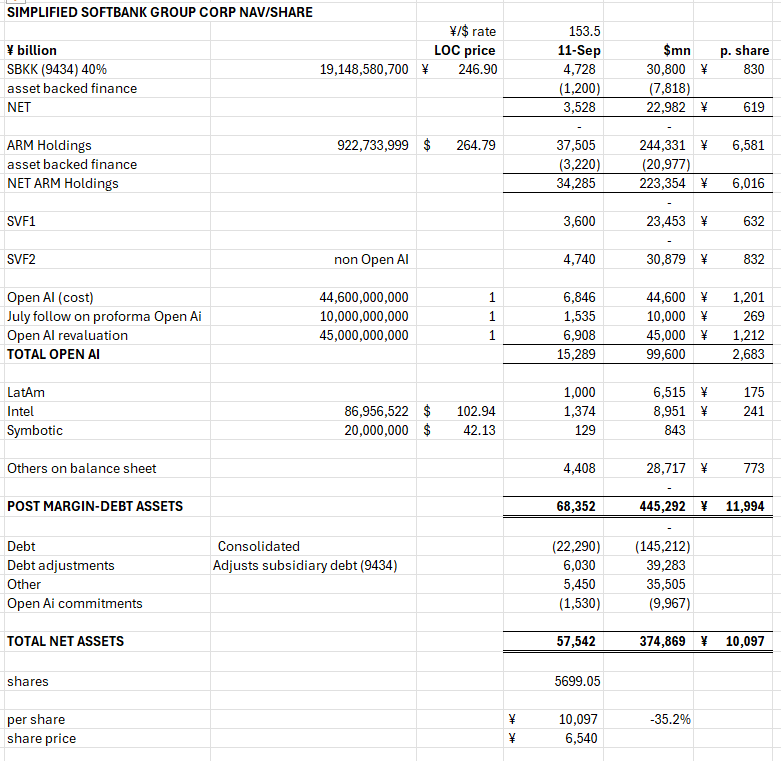
9434 (40% owned) listed in Tokyo) priced at ¥4.7trillion (henceforth T) or US$30.8bn against which there is a ¥1.2T margin loan so net ¥3.5T (US$23bn) or ¥619/share;
ARM (86.4% owned) US listed and priced at US$244bn with a US$21bn margin loan = $223bn net of loan or ¥34.3T = ¥6,016/share.
On its main balance sheet 9984 has a near US$9bn investment in Intel, an assortment of other listed securities, assets which will make up the new SB Energy IPO, and the holdings in three funds which had/have “outside” capital:
Softbank Vision Fund 1 (SVF 1) of which 9984 owns around 33% but has management rights and performance fees - carried at ¥3.6T (US$23.4billion) with SVF1 largely in rundown mode;
SVF2 where 9984 owns 100% of the publicly listed investments as of June 2021, and 82.75% of the private investments and public investments after June 2021 with Masa carried for the performance economics of 17.25% of the latter from June 2021 with payments deferred;
LatAm with a similar 82.75%/17.25% performance economics split with 9984; and
Masa controlling 33.3% of the asset management subsidiaries.
This related party set up realistically came about with 9984 trading at a 55% or so discount to NAV and widespread disgruntlement over the state of WeWork nearly two years after Adam Neumann had been forced out of the company.
SVF1 was particularly “controversial” with significant committed Middle East participation - Saudi PIF committed US$45billion, Mubadala (Abu Dhabi) $15billion and assorted small third parties - against ~$27billion by 9984 and where performance was initially poor due to losses on WeWork and Didi. Moreover, SVF1 ended up acquiring most of Arm Holdings after its $32billion takeover in September 2016 off the LSE; in a second hefty boot to the SVF1 testacles, 9984 itself acquired most of the ARM shares prior to its US IPO in September 2023 at an effective equity valuation of $54billion and which now has a market capitalisation of $283billion
The mooted Middle Eastern investments in SVF2 never materialised and it has been virtually exclusively funded by 9984, with the Masa performance participation.
Hence, 9984 is a complex beast with 373 private investments within the SVF structures and 46 publicly listed entities, with the largest being Coupang (17.7% valued at ~$4.4billion); PayPay (28.5% at $3.56bn) and Grab Holdings (10.1% at $1.22bn)
Our very simplified breakdown of 9984’s NAV is given in the table below; it is subject to more than the usual caveats given the performance fee structure and Masa carry within SVF2 and we may have not correctly calculated various aspects of these arrangements. It is no more than a guide:
Open AI
9984 is a major beneficiary if capital markets remain open to publicly list and place a market value on currently unprofitable but expected future growth ventures, notably in data centres and Open AI. It is noteworthy that a turning point for 9984 was the public listing of only 10% of ARM Holdings which provided a hitherto cynical view regarding the price of the takeover and its carrying value - manifested in the willingness of the SVF1 holders to allow 9984 to repurchase.
9984 shares have recently strengthened - up 38% in six trading days to 9 September 2026 - reflecting a perceived discount to NAV of over 60% allied to the lodgement of an S1 for SB Energy (SBE) in the US, the data centre and generation business. The S1 filing shows operating revenue running at ~$140million annualised, operating loss of $640million before financing costs and a debt load of $1.8billion. SBE has three integrated facilities under construction covering 800MW of capacity at its Texas facility but has contracted capacity of 8GW at the Pike, Ohio site. Of course, the major tenant of Pike is Open AI, with infrastructure exclusively provided by NVIDIA. It is the classic round robin within the prevailing AI financing structures. Simplified details of SBE are in this brief WSJ article Rumoured deal value for SBE - no details of the construct or likely percentages left with 9984 - is $50billion.
9984 has a direct $100billion exposure to Open AI equity, with a further $10billion commitment due in October 2026; the existing exposure is equivalent to ~¥2700 per share. 9984 carries its Open AI equity exposure at a valuation of ~$730million; by October it will have invested $65million for a 13% stake - a $500mn value for Open AI at cost - but wrote up fair value in the March 2026 quarter. The latest February 2026 Open AI $110billion funding round, in which 9984 was a $30billion participant (with $30bn from NVIDIA and $50bn from Amazon) used that $730million valuation.
In recent days, Open AI has pushed back the intended date of IPO into 2027, ostensibly on the basis of “safety” and “consolidation”; perhaps the $21billion operating loss on revenue of $13billion was a factor together with its ongoing commitments such as those to SBE.
Open AI represents ~22% of 9984’s gross value, as opposed to ARM - which after margin loan - is virtually half of Softbank’s gross assets. ARM trades at a March 2029 free cash flow yield of ~1.4%, EV/revenues of 26x and a P/E of 55x that year’s consensus projections. Its equity is valued at 9x the takeout price of 2016.
What can we learn from 9984 share price behaviour?
The only realistic manner to assess 9984 is via NAV, for which the company provide their estimate based on listed market prices, where applicable on a quarterly basis. There’s no doubt you will find a polymath who can dig further through the hundreds of smaller private investments within the group and may find a hidden NAV-moving gem in there.
As a controlled entity, there will always be a meaningful level of discount. In 9984’s case, this is amplified by:
the opaque and complex nature of disclosures - the SVF funds are usually couched on the basis of returns from inception;
significant private exposures, notably Open AI but also within SVF2;
conflicted corporate governance, where the interests of Masa are arguably placed ahead of other shareholders through related party arrangements and his ultimate decision making;
historic and ongoing willingness to make massive proportional “bets”;
Opaque and complex and corp governance = big discount; and
that these factors, together with the underlying investments contribute to enormous stock price volatility.
Stock price volatility
As a guide for those not around in the dot.com period, in the last throes of the mania in early 2000, 9984 shares doubled in a month between mid January 2000 to mid February 2000 (¥1193 to ¥2527) before tanking to ¥772 by April as the bust took hold, ¥125 by January 2001, below ¥100 by October 2001 and a nadir of ¥39 in October 2002 over a 98% loss.
In its most recent cycle, 9984 shares bottomed out at a split adjusted ¥1432 in early April 2025. That’s six months after the initial investment in Open AI and eighteen months after the most important recent moment in 9984 history: the IPO of 10% of ARM Holdings.
Since then, at their recent peak the shares advanced nearly five-fold, nearly touching ¥7000 in the second week of September. Since March 2025, just before the shares bottomed and a week ahead of the “Liberation Day” lows of US equity markets, 9984 shares have exhibited an average absolute daily move (from previous close) of 3.7% (and intra-day range - high over low - of 4.9%). In 2026 alone, as the AI boom has taken hold, the average daily move up or down from prior close has widened to 4.34% and the high/low daily range is a staggering 5.95%.
On over 7% of trading days since end-March 2025 - including today - 9984 shares have risen or fallen over 10% - remember, this has averaged being a $160billion plus company!
Discount to NAV
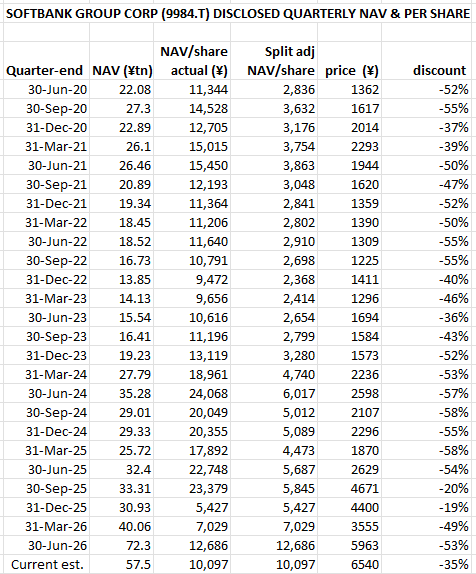
Recent weakness in US$/¥en rates has been a headwind to 9984 NAV given the bulk of the assets are denominated in US$; this has contributed to our estimate of a sharp 20% decline in NAV since the June quarter end, based on no major changes to 9984 construct since that time. The prevailing 35% discount is below the quarter-end average since 2020 of ~47% and that 12% of the NAV (¥1212/share) is the revaluation increment on Open AI:
Conclusion
Softbank represents an archetypal play on AI - it has feet in both the “supplier” (via architecture) and “builder/scaler” camps, with a bias to the former. Riding this wave, its notional NAV increased over four-fold from end 2022 to the recent assessed peak in March, aided by a weak ¥en as well as increased share prices. In the author’s eyes, away from the major US mega-tech securities, 9984 represents the clearest - if not cleanest - indicator of sentiment within the AI space.
Andrew Brown
14 September 2026
The author has NO relevant interest in the securities of Softbank Group Corporation
This disclaimer applies to this document and the verbal or written comments of any person presenting it. The document taken together with any such verbal or written comments, is referred to herein as the “Presentation.” This Presentation is general background information, is current at the date of the Presentation and does not purport to be complete.
All share prices are as at 11 September 2026 or the date noted in the relevant slide. All values are in local currencies unless otherwise stated. All information is sourced from company reports, tikr.com for consensus estimates and compiled by Andrew Brown. The Presentation does not constitute an offer to sell, or a solicitation of an offer to buy, any security and may not be relied upon in connection with the purchase or sale of any security. Any such offer would only be made by means of formal offering documents, the terms of which would govern in all respects. You are cautioned against using this information as the basis for making a decision to purchase any security mentioned within the Presentation.
Andrew Brown is the sole Director of East 72 Management Pty Limited (ACN 663980541) which is Corporate Authorised Representative 001300340 of Westferry Operations Pty Limited (ABN 48 103 724 072) (AFSL 302802). Andrew Brown is the Responsible Manager for Westferry Operations Pty Limited. The information contained in this presentation is of general background and does not purport to be complete. It is not intended to be relied upon as advice to investors or potential investors and does not take into account the investment objectives, financial situation or needs of any particular investor. These should be considered, with or without professional advice, when deciding if an investment is appropriate. Andrew Brown and his related bodies corporate (“Brown Parties”) and any of their respective officers, directors and employees do not warrant the accuracy or reliability of this information, and disclaim any responsibility and liability flowing from the use of this information by any party. To the maximum extent permitted by law, the Brown Parties do not accept any liability to any person, organisation or entity for any loss or damage suffered as a result of reliance on this document.
Forward Looking Statements
This document contains certain forward looking statements and comments about future events.Forward looking statements can generally be identified by the use of forward looking words such as, ‘expect’, ‘anticipate’, ‘likely’, ‘intend’, ‘should’, ‘could’, ‘may’, ‘predict’, ‘plan’, ‘propose’, ‘will’, ‘believe’, ‘forecast’, ‘estimate’, ‘target’ and other similar expressions within the meaning of securities laws of applicable jurisdictions. Indications of, and guidance on, future earnings or financial position or performance are also forward -looking statements.. Forward looking statements involve inherent risks and uncertainties, both general and specific, and there is a risk that such predictions, forecasts, projections and other forward-looking statements will not be achieved. Forward looking statements are provided as a general guide only and should not be relied on as an indication or guarantee of future performance. Forward looking statements involve known and unknown risks, uncertainty and other factors which can cause actual results to differ materially from the plans, objectives, expectations, estimates and intentions expressed in such forward looking statements and many of these factors are outside the control of Brown Parties. As such, undue reliance should not be placed on any forward looking statement. Past performance is not necessarily a guide to future performance and no representation or warranty is made by any person as to the likelihood of achievement or reasonableness of any forward looking statements, forecast financial information or other forecast. Nothing contained in this Presentation nor any information made available to you is, or shall be relied upon as, a promise, representation, warranty or guarantee as to the past, present or the future performance of the securities mentioned herein. The information in the Presentation is provided to you as of the dates indicated, and Brown Parties do not intend to update the information after its distribution, even in the event that the information becomes materially inaccurate. Certain information contained in the Presentation includes calculations or figures that have been prepared internally and have not been audited or verified by a third